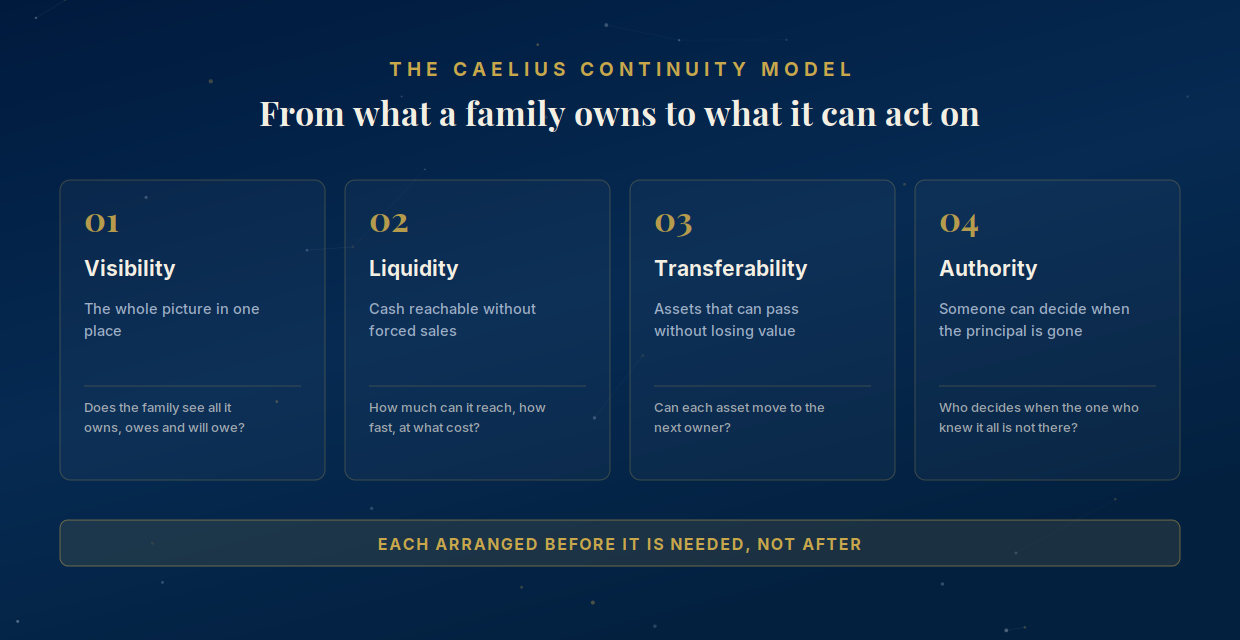
The Caelius Continuity Model

From what a family owns to what it can act on

The Caelius Continuity Model: visibility, liquidity, transferability and authority, each arranged before it is needed.

A balance sheet shows what a family owns. It says almost nothing about whether the family can act when it must, when a market turns or when a generation does. That difference, between owned and usable, is invisible on a statement and decisive in a crisis. Our work rests on four things, each of which has to be in place before the moment that tests it.

01

Visibility

The whole picture in one place

What the family owns, what it owes, and when the demands fall due, gathered in a single view. Without it, every decision is made blind and every obligation arrives as a surprise.

What we coordinate

We coordinate consolidation, reporting and the calendar of obligations, so the working picture is the real one and not the flattering one.

What the evidence says

UBS Global Family Office Report · 2026

Most family offices surveyed measure investment performance formally and run investment committees, yet far fewer have board level governance over the whole enterprise. Depth in one part of the picture can hide the absence of a single consolidated view of the rest.

Our reading. Measurement is not visibility. The value is one consolidated picture, not many separate dashboards.

View the source ↗

KPMG Global Family Business Report · 2026

KPMG describes a shift from the family run business to the family owned enterprise, which asks the family to be deliberate about what it oversees rather than what it manages day to day.

Our reading. Owning well begins with seeing the whole, the businesses, the structures and the obligations, in one place.

View the source ↗
02

Liquidity

Cash reachable without forced sales

What the family can reach, quickly, without selling the wrong thing at the wrong time. Net worth is not liquidity, and the cost of reaching cash is set by how prepared the family is before it needs to.

What we coordinate

We coordinate the liquidity map, a reserve sized to real obligations rather than a round percentage, and borrowing capacity arranged while the balance sheet is strong.

What the evidence says

Federal Reserve Survey of Consumer Finances · United States

For families that own a business, that business is typically among the largest single holdings on the balance sheet, and one of the least liquid.

Our reading. Concentration like this is why the binding constraint is liquidity, not net worth.

View the source ↗

Caelius Perspectives, The Liquidity Series · 2026

Our own treatment of this dimension: why net worth is not liquidity, and why liquidity is cheapest when you do not need it.

Read the essays →
03

Transferability

Assets that can pass without losing value

Whether each asset can actually pass to the next owner without destroying the value it took a lifetime to build. An operating company, a property, a private structure: each moves differently, and some do not move at all without preparation.

What we coordinate

We coordinate the readiness of assets for transfer, alongside the family's legal and tax advisers.

What the evidence says

UBS and University of St. Gallen · 2026

In a large Swiss study, many owners expected to transfer their business within five years, most said its success was still tied to the owner, and the researchers judged that only around two thirds of intended transfers carried a low enough risk of failure. Intention and transferability are different questions.

Our reading. A named successor is not a transferable asset. Readiness is what makes the transfer survivable.

View the source ↗

Boston Consulting Group · 2026

BCG frames modern succession as a design problem, noting that equal division can fragment control and that values, networks, reputation and institutional knowledge do not pass automatically through a trust or a will.

Our reading. Transferability is engineered before the event, and it covers more than the financial assets.

View the source ↗
04

Authority

Someone can decide when the principal is gone

Who can decide when the person who understood the whole picture is no longer there. Sophisticated arrangements routinely coexist with a single point of failure.

What we coordinate

We coordinate the governance and the operating backbone so that authority survives any one individual, and a family office continues to function when the principal does not.

What the evidence says

J.P. Morgan Private Bank Global Family Office Report · 2026

Across single family offices representing very large pools of wealth, the great majority had no clear succession plan for their key decision makers, even where investment governance was highly developed.

Our reading. Institutionalising the management of money does not institutionalise the authority to run it.

View the source ↗

UBS and Agreus, Family Enterprise Governance Report · 2026

Within a small and wealthy sample, families that carried out succession planning were markedly more likely to consider the next generation prepared. This is an association within a specialised group rather than proof of cause, but it points to which practices accompany readiness.

Our reading. Authority is a practised capability, not a document filed and forgotten.

View the source ↗

Deloitte Private · 2026

Most participating families reported having a succession plan, only about half described it as thorough, and only a minority were highly confident that the next generation was prepared. A plan is not the same as preparedness.

Our reading. The gap between a named successor and a ready one is exactly where authority has to be built in advance.

View the source ↗

Independent institutional and academic research, read against each dimension. The summaries are our own and each links to the source. This is commentary, not advice.

Before, not after

Each of the four is cheapest, and often only possible, when it is arranged ahead of the event. A family that waits for the market to turn, or for a succession, to build visibility, liquidity, transferability or authority is building it at the worst moment, at the highest cost, and sometimes too late.

We coordinate and prepare. We do not provide regulated legal, tax, audit, investment or lending services; those remain with the family and its regulated advisers.